![[ Center for Humane Technology ]](https://substackcdn.com/image/fetch/$s_!uhgK!,w_80,h_80,c_fill,f_webp,q_auto:good,fl_progressive:steep,g_auto/https%3A%2F%2Fsubstack-post-media.s3.amazonaws.com%2Fpublic%2Fimages%2F5f9f5ef8-865a-4eb3-b23e-c8dfdc8401d2_518x518.png)
We Solved Global Crises Before. Can We Do It Again?
Key Takeaways from Susan Solomon on Your Undivided Attention.


When the hole in the ozone layer was discovered in the mid-1980s, it felt like humanity was staring at the sky and seeing our own fragility. Life on Earth itself was at risk. Yet, remarkably, nations, industries, and individuals came together to solve the problem.
In this week’s Your Undivided Attention, Tristan Harris and Aza Raskin speak with Susan Solomon, MIT professor, Nobel Peace Prize–winning atmospheric scientist, and one of the scientists who first measured the ozone hole. Her book Solvable: How We Healed the Earth, and How We Can Do It Again argues that we can learn from past crises to confront today’s overwhelming challenges, from climate change to the AI race.
This episode is a blueprint for what is possible.
The Crisis That United Humanity—and Why It Matters for AI
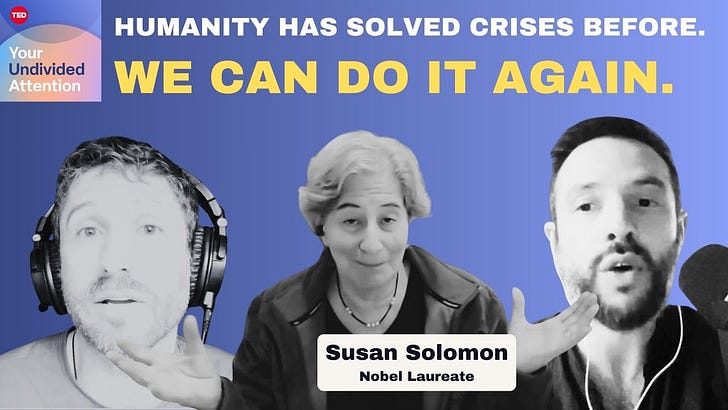
In 1985, scientists in Antarctica discovered a hole in the ozone layer that posed a catastrophic threat to life on earth if we didn’t do something about it. Then, something amazing happened: humanity rallied together to solve the problem.
Lessons from Montreal: Defeating the “Inevitable”
The 1987 Montreal Protocol was a once-unthinkable achievement: 198 countries agreed to phase out chlorofluorocarbons (CFCs), the chemicals responsible for destroying the ozone layer. Today, 99% of these chemicals are gone and the ozone is healing
Solomon identifies three key conditions that made success possible: the Three P’s:
Personal: The threat hit home. Skin cancer and cataracts made the risk tangible.
Perceptible: Satellite images showed a gaping hole in Earth’s atmosphere.
Practical: Alternatives existed, from stick deodorants to safer refrigerants.
When people can see a crisis, feel its personal stakes, and grasp a practical path forward, change becomes possible.
It Starts with Consumers
There were two phases to solving the ozone crisis and they built on each other.
Phase One: In the 1970s, scientists began to warn people that CFCs—which were in everything from hairspray to deodorants—might start to have a really serious effect on ozone. The American public took this warning seriously and started to choose alternatives. The sales for CFC products plummeted. Importantly, this consumer shift happened only in the United States.
Phase Two: Then, along comes the ozone hole. In 1985, scientists discovered a massive reduction in ozone over the antarctic, despite the drawback from CFC products. This scared governments enough to come to the negotiating table, with the United States leading the charge because of their declining market share.
The bottom line is that consumer action is the best way to jumpstart institutional action. People have the power to steer us to a better future, if we choose to use it.
“I don't know whether anything would've happened on ozone if the American public hadn't switched away from spray cans. Every time I go back and think about it, I think that is what opened that bottleneck” - Susan Solomon
What Made Montreal Work
Susan identified three features of the Montreal protocol that made it successful:
The change was incremental: “negotiations are always best done when they are slow and steady, and that's something that people have a lot of difficulty understanding nowadays. I think we want an instant solution. And what happened with the Montreal Protocol was anything but instant really. When you look back on it, the original protocol just said, ‘Okay, we're going to freeze production at current rates, so you'll still be allowed to produce but you just won't be allowed to produce more than you did the year before.’”
Poorer nations were protected from exploitation: “Developing countries got what they needed to be assured that they weren't going to be exploited in this protocol and that's a very important thing in every international agreement. So, everybody got a little bit of something, that's how international negotiations work.”
There was collaboration between government, industry and scientists: “Another thing that was really important for the Montreal Protocol was its advisory structure…They created groups of scientists who would provide them with assessment reports, and they were required to do the assessment reports internationally. So, there was a science assessment report, a technology report…an impacts and economics group…and that was the information that the policymakers had to begin to plan.”
Technology-Steering: Forcing Innovation
A striking lesson from past environmental wins is the role of “technology-steering” policies. These policies do not just regulate. They demand innovation.
The U.S. Clean Air Act required a 90% reduction in auto emissions, which forced the invention of the catalytic converter.
Montreal forced chemical companies to collaborate and innovate alternatives.
Industries initially resist, but once incentives shift, they often become allies. As Solomon puts it: “Companies are like cats. They don’t like it when you move the furniture around. But if you do, they adapt.”
Building Institutional Memory
Montreal did not just solve one crisis. It built the infrastructure of trust and process that made the 2016 Kigali Amendment possible, which phased down another class of greenhouse gases (HFCs). Each coordinated success sets the stage for the next.
This reminds us that progress is incremental. Skeleton frameworks, even if modest at first, create the channels for bigger breakthroughs later.
From Ozone to AI: Making Cold Crises Hot
Many of today’s challenges, from climate change to AI, are what Solomon calls “cold crises.” They creep forward without the dramatic shock of a hole in the sky. The danger is apathy.
The parallel to AI is striking. Like CFCs, AI is produced by a handful of powerful companies. Like CFCs, it comes with enormous profits and enormous risks. And like with CFCs, we are told the trajectory is inevitable.
But inevitability is a spell, and Montreal proves it can be broken. As Tristan noted in the episode: “If everyone believes a problem is inevitable, it becomes a self-fulfilling prophecy.”
The task is to make AI’s risks personal, perceptible, and practical. We need to show how it touches daily lives, from AI companions to misinformation, and to demand real alternatives.
Hope Without Naïveté
Susan Solomon resists fatalism. She reminds us that paralysis in the face of uncertainty is the worst response of all. Every fraction of a degree of warming avoided, every step toward humane technology, counts.
The story of the ozone hole is proof. Even when the threat is global, even when industries resist, even when coordination seems impossible, humanity can act with foresight.
If we did it once, we can do it again.