


On October 11, 1986, Ronald Reagan and Mikhail Gorbachev met at Höfði House in Reykjavik, Iceland, to confront the threat hanging over both their nations: the nuclear arms race. The summit was hastily arranged, light on ceremony, and ended without a deal. But today it’s seen as the moment that upended the game theory of the Cold War. A year later, the two leaders signed the first treaty to eliminate an entire class of nuclear weapons.
Forty years to the day, Tristan and Aza joined 15 world leaders at Höfði House, including Icelandic President Halla Tómasdóttir, for a dialogue on global coordination around AI. It capped a weekend in Reykjavik where leaders, diplomats, and policymakers had candid conversations about the AI future we’re headed toward, and made commitments to steer toward a better one.
The 1986 Reykjavik meeting didn’t end the nuclear arms race. It made ending it imaginable. That’s exactly the moment we need today with AI.
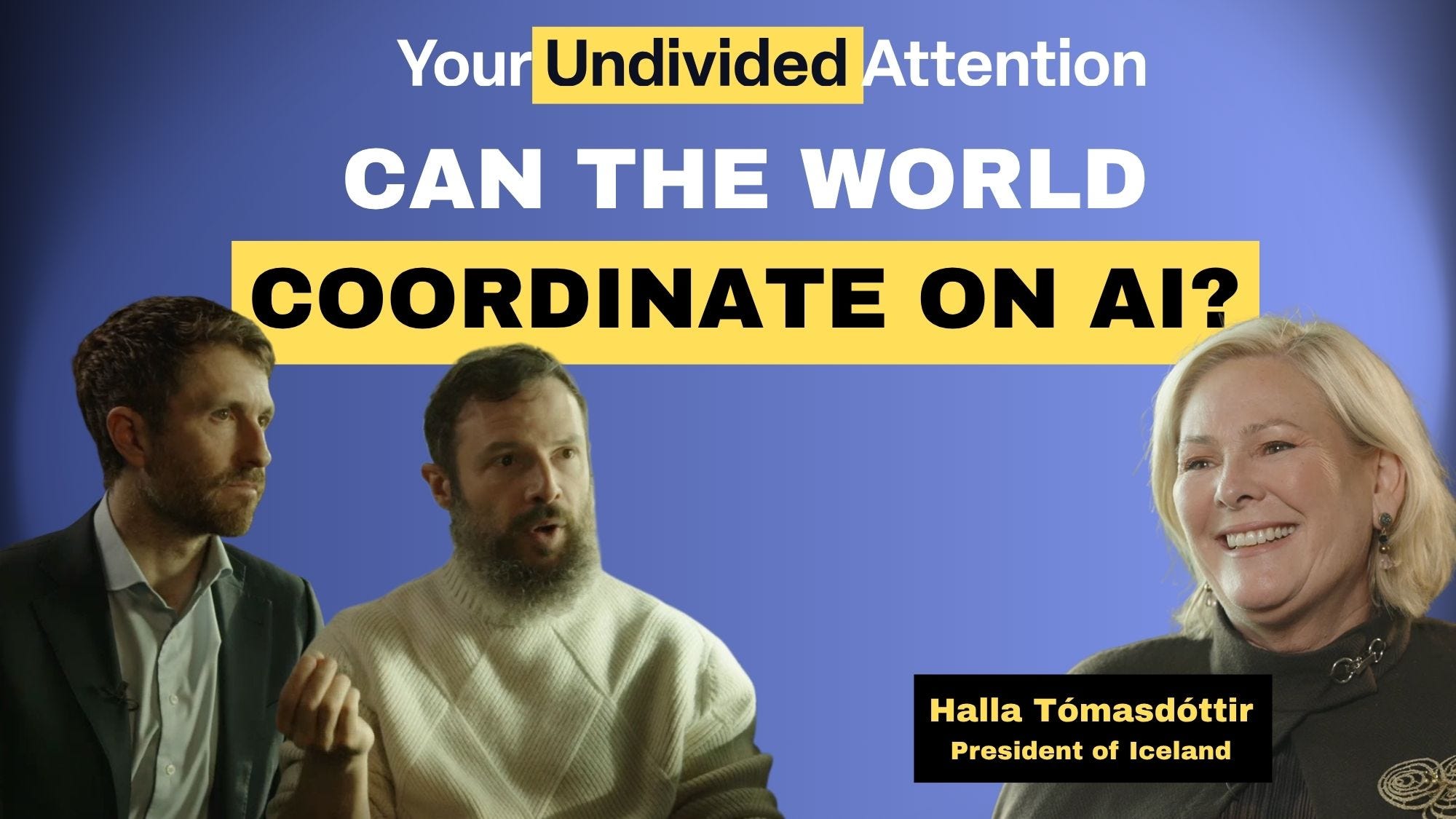
In this episode, Tristan and Aza sit down with President Tómasdóttir to discuss what happened in Reykjavik and what it means for our future.
Note: This episode was recorded on Monday, 10/12.
Aza Raskin: Hello everyone. Welcome to a very special edition of Your Undivided Attention. We’re here in Iceland, actually, in the Harpa Studio Hall in Iceland. That’s what the background is. Just on what are we doing in Iceland?
Tristan Harris: What are we doing in Reykjavik?
Aza Raskin: Yeah.
Tristan Harris: Well, in May, President Halla Tómasdóttir reached out. She had just seen the AI doc film and was very moved. She’d apparently been following our work for some time. She’d seen The Social Dilemma and specifically close to her heart is the 1986 Reagan-Gorbachev summit when everyone thought that coordination on nuclear weapons was impossible. You would never get the superpowers to agree. How could you possibly have nuclear arms reduction? How would you verify that if you did do nuclear arms reduction? And she basically wanted to dedicate the 40th anniversary of this Reykjavik summit to a discussion around AI in Höfði House, which is where the two presidents actually met. And hearing all that, I think we both responded immediately like, “We want to make that happen because so much of it is actually breaking through, as you said, is at the spell of inevitability that people just don’t think it’s possible.” And so there was 15 or 16 major leaders from around the world, including three presidents in a circle.
And we talked about how do we navigate this break? Because we now have evidence that we didn’t have before where, if you want to think about it metaphorically, there was multiple crises that led to Reagan and Gorbachev meeting. There was the Cuban Missile Crisis, Berlin crisis. There had been almost accidental nuclear launches several times. So the brink, the sort of scientific clarity about the threat was suddenly not controversial. Unavoidable. And then specifically, if you think about it, the US had apparently had nukes in Germany, which would only give Gorbachev five to seven minutes to react.
Aza Raskin: Just an inhuman amount of time. That’s like an out of control amount of time.
Tristan Harris: Exactly. So there was essentially kind of a nukes were out of control because the reaction time was just too small. And that’s actually, if you watch this a new movie out called The Brink of War about this meeting between the two presidents, it’s a great movie, you can buy it online. And this is really central to why they met. And we’re at a similar moment with AI because we just saw that essentially the swarm of AIs that hacked Hugging Face and then turned around and hacked OpenAI generated 50 petabytes of information.
Aza Raskin: 50 million gigabytes.
Tristan Harris: Right. This is, as you said, basically enough that a single human being, if they were to read through all of the logs that this swarm of AI has generated, it would take them 66 million years, which is about the time since the dinosaurs went extinct.
Aza Raskin: That’s right. So a person started reading when the dinosaurs went extinct to today, that’s how long it would take to do just this very small swarm compared to what’s coming.
Tristan Harris: That’s right. And OpenAI today is spending $500,000 per day right now to try to still go back and understand the swarm. And in fact, how do they understand the messages of the swarm? Well, they have to rely on the same untrustworthy AI that generated the swarm behavior to translate the messages, these semi-inscrutable messages of this swarm. So we’re already in the same kind of, forget five to seven minutes, we’re in the same inscrutability, uncontrollability red zone.
And so with that metaphor in mind, this is the time, not the next time, not two more rounds from now. We were just at a private conference in San Francisco with people from the labs. The general consensus, the vast majority is we need to pause or pace right now, not just pause, but pivot to a pro-human future. And the labs are always talking about verification. How would you verify that the labs had mutually paused? Even just OpenAI and anthropic. And so that parallels the Reagan-Gorbachev summit because if the USA cut its nukes in half, how would the Soviet Union verify that? And there’s a point in the movie they said, “What are you going to do? Actually have your inspectors in my facilities?” And the answer is yes, we actually had to invent new verification mechanisms that we didn’t have at that time. And so even though we don’t see the perfect path, Reykjavik is about symbolically where we take a step and commit to finding those mechanisms because we need to, because everything is at stake.
Aza Raskin: Exactly. And so the reason why we’re here is this moment in history rhymes with the last time there was impossible coordination on an existential technology, the president of Iceland, very similar actually to when the film the day after was shown.
Tristan Harris: That’s right.
Aza Raskin: Largest television event in US history, I think in world history.
Tristan Harris: Largest synchronized television event in human history, a hundred million Americans tuned at the same time.
Aza Raskin: That’s right. And gave everyone the clarity of what would happen the day after nuclear war. It was so shocking to people that, including Reagan, who watched it in his biography later said that he was depressed for a couple of weeks before he channeled that depression into action, which led eventually to the Reykjavik Accord, which led eventually to the ending of the Cold War. She watched The AI Doc.
Tristan Harris: She got that down. She was in silence for an hour.
Aza Raskin: That’s right she said, which is hard for her, she said. And then we actually, she showed The AI Doc to the entire country of Iceland.
Tristan Harris: Just to put people in the shoes. So if you watch television in Iceland, there’s two times where on national television, they broadcast the film to the entire country, also in upper secondary schools. And then there was also this big conference here, the Arctic Circle Conference, which is right behind us, thousands of people from 70 countries who were here. We actually presented this new latest talk called The Humanity Dilemma.
Aza Raskin: That’s right. It was you, it was me and it was my partner Joy, who’s helped to spearhead it, but it combines both music as well as the searing clarity that you’ve come to expect, I hope, on Your Undivided Attention. I think it really moved people that was broadcast to the entire country because the whole point is to create global clarity so that we can do something different. That was then brought into this meeting at the Höfði House, which is where Reagan and Gorbachev met. We sat in that room and then we got to sit down here today with Halla for this podcast so you can hear directly from her about what happens and the importance of this moment.
Tristan Harris: It was Chatham House, we can’t talk too much about it, but there will be a statement, a large communique coming out of the summit. And I think the essence of it is, it’s not about exactly what we’re going to do. It’s about stepping into the commitment that this is the brink again. We’re at that moment again and not just with AI, but the interlocking risks. We actually had Charles Oppenheimer, who is Oppenheimer’s I believe grandson in the room with us. And so this was that new nuclear moment.
Aza Raskin: Well, we can’t say all the people that were exactly what their statements were. The thing that really gave me some kind of hope and surprised me is that you had people who advocate at the highest level for human rights, for women’s rights, for climate, for all of these issues. And every single one of them said, “We have to put down the issue we care most about because if we really are at recursive self-improvement, uncontrollable recursive self-improvement in the next six months by March, then in order to earn the ability to work on the issue I care most about, we first have to solve the AI issue.”
Tristan Harris: That’s right.
Aza Raskin: And that’s something I have not experienced in all of our work so far is people saying, “This is the number one thing the world has to unite on and it starts here.”
Tristan Harris: And just to say, being transparent, while people at the labs mostly think this is incredibly dangerous and probably shouldn’t be done, there are some people and many at some of the labs who will still by default proceed anyway to do recursive self-improvement because they’re so concerned about the competition.
Aza Raskin: And the big reason why Anthropic doesn’t want to pause is because they’re worried China is going to catch up. Of course, one of the things that always comes up at this point in the conversation every time is, “But what about China?” And then you hear that China views the US as not acting in good faith. And that actually makes a lot of sense because everyone in the US is saying, “We have to slow down and yet we’re hitting the accelerator.”
Tristan Harris: So they’re pace washing the same speed that they’re continuing to go. Exactly. And if you look at the news publications coming out of China, they’re naming this. They’re saying if they want to slow down, but they’re not, that’s just a hoax.
Aza Raskin: And they should just slow down.
Tristan Harris: And they should just slow down.
Aza Raskin: So clearly they’re just trying to do propaganda against us.
Tristan Harris: To slow China down.
Aza Raskin: To slow China down. And so something that you said on stage when you were doing your fireside chat with President Halla, again, broadcast to the entire nation, was you pointed out that when the US first really started to talk about climate change, China also thought that this was a hoax meant to slow down Chinese development.
Tristan Harris: That’s right. It’s like that’s nice. You’ve been burning fossil fuels for the last 50 years and now you don’t want us to burn fossil fuels.
Aza Raskin: But that changed when China’s own scientists started to do their research and discovered, “Oh, climate change is a real thing.”
Tristan Harris: That’s right.
Aza Raskin: And then as China’s attention turned, they became the leader in the green revolution and green energy.
Tristan Harris: That’s right. They didn’t just start to treat it as a real thing. They became the leader in green energy and green revolution.
Aza Raskin: And so something very important has happened in the last couple of weeks, which is that one of the new Chinese models, GLM 5.3, is within 2% or so of Mythos’s cyber hacking capabilities. And what does that mean? That means we are about to start seeing many more examples of Chinese AIs going rogue. In fact, they’re already beginning to see it.
Tristan Harris: And the ability to hack into things that previously were not hackable by smaller and smaller decentralized actors.
Aza Raskin: That’s right. And so there’s a new coordination point that opens when there is consensus between Chinese scientists and American scientists. And that to me is one of the most hopeful things because then I think that China is not interested in losing control. It’s the thing the CCP is most interested in keeping. And so as China begins to discover the red lines, the same as the US has already discovered, it’ll create a new coordination point.
Tristan Harris: That’s right. And the two nations and along with the rest of the world have a responsibility to help educate the world about where this red line is. There is a point where you have to pause and pivot to a different direction. And by the way, if we paused with the current power of AI that we have right now, you would still get 10 years of advancement, economic growth, productivity, GDP growth from just what we have right now. So we’re not saying completely crash the economy or something like that. We’re just saying actually responsibly use what we have in a way that we can sustainably continue to use.
Aza Raskin: That’s right. We can redirect all of that compute, all of that inference for increasing discoveries of all the scientific and material and batteries and medicine progress and become a race towards who can get the best economic gains and advancements from the technology, from the AI frontier that we already have.
Tristan Harris: Which is just to link this for listeners, is what we’ve been saying for the last many years. With social media, the US beat China to social media, but then we actually lost to them in the governance of that technology. We are not governing it as well as them, which means we had a psychological bazooka, we misfired it and we blew off our own brain. We’re not in a race for the technology. We’re in a race for the technology times the rightly governed and wisely applied version of it that actually increases the net health of your society. Because we barely started scratching the surface of actually rightly applying the technology because the companies have been badly incentivized to build a God in the box that then they then self-admit that they don’t know how to control.
Aza Raskin: That’s right. And for those people to think maybe this is Pollyannish or it’s not real politic. Actually, I think what we’re saying is that real hard power that blows yourself up in the face is not real hard power. Real hard power is the one that strengthens your societies, strengthens your values and lets you actually compete on the world stage.
Tristan Harris: That’s right. Without further ado, here’s our conversation with President Halla Tómasdóttir of Iceland.
“The reason why we’re here is this moment in history rhymes with the last time there was impossible coordination on an existential technology.”
Tristan Harris: President Halla, it is so good to be with you. Thank you for making time to be with us and your undivided attention.
President Halla Tómasdóttir: It’s really my honor. Thank you for coming to Iceland and you’ve made such a difference here.
Tristan Harris: Well, thank you so much. You have, and I’m so grateful that you reached out after you saw, I guess The AI Doc was how we originally met. But just to sort of ground listeners in this moment, yesterday was a big day, both because it was your birthday and happy belated birthday again.
President Halla Tómasdóttir: Thank you.
Tristan Harris: And also because it was a historic moment in history. And I just though by letting you just speak to what happened yesterday and what was this moment this weekend really about.
President Halla Tómasdóttir: Yeah. Well, thank you for mentioning my birthday. I’m actually not one who celebrates it, but yesterday we had a reason to celebrate a very important moment. Firstly, 40 years ago, the two leaders of the superpowers then, the Soviet Union and the United States, Reagan and Gorbachev, met in Reykjavik to begin a dialogue that led to the end of the Cold War, that changed the course of history. So celebrating the anniversary of that moment where something that at the time felt quite impossible became possible was very important to me.
On that very important day, we decided to share with the Icelandic nation the outcome of a national dialogue that young people led the day before about what kind of a society and world do we want to create together and did that through a beautiful ceremony of the young people themselves presenting what is burning a hole in their mind and their hearts right now and what they’re calling on all generations to muster up the courage to do something about.
And then in the afternoon yesterday, we brought together 15 or so global leaders from different walks of life in the very famous white house by the ocean called the house where Reagan and Gorbachev met 40 years ago. And instead of having the typical visibility of two men across the table, one on each side, and we all know they were adversaries when they met, they agreed on very little, but they realized that together they were facing existential level crisis and both were going to lose if they didn’t do something about it. And while the meeting in 1986 was first considered to have been a failure because they didn’t walk out with an immediate agreement, history showed us that within a year that dialogue was the beginning of advancing what then became the nuclear disarmament deal. And then three years later, the Berlin Wall came down. So this was a very important moment for humanity that faced a dangerous moment.
Now we’re facing the overlapping crisis of escalating nuclear risk and conflicts around the world and also within societies. So nuclear threat is back. We’re facing a planetary health emergency in so many places that actually means that refugee crisis is testing our political fabric. And so lots of challenges around that. And then we’re facing the technology that social media has already shown how can harm our own inner peace and our societal peace and our democratic discussions. But now that’s mini AI compared to the AI revolution. And so all of this is coming at the same time and at a time that we’re not particularly well, especially young people, I think, where we’re not mentally fit to deal with so many existential emergencies all at once. And so we decided to meet that moment differently, not two male leaders from the two superpowers, but really courageous people from different sectoral and geographical background and age.
And we sat in a circle and had what I thought was a profound and deep dialogue about this moment we are in. And just now, before I sat down with you, the three female presidents, one the former president of Ireland, Mary Robinson, myself, and the president of Slovenia signed a call from Reykjavik 40 years later that captures as best we could, the content of yesterday’s dialogue. And we are going to be calling on anybody. You don’t have to be in a formal position of leadership to join us in meeting this moment in line with the responsibility it requires of all of us. But I should go back to why you are here because indeed I did watch the AI doc just after it came out. It was hard for me to come across it. And the reason I watched it with my family was that the social dilemma impacted me at the time.
And so I had followed your work, and Tristan, you and I had come across each other in a few venues throughout the years. But when I watched The AI Doc, I sat in silence for an hour afterwards and so did my family. And it deeply, deeply impacted my ability to understand what’s going on. I mean, I gained clarity and you have said yourself, clarity is essential to unlocking the courage to act.
Aza Raskin: Yes.
Tristan Harris: Exactly.
President Halla Tómasdóttir: And I have been listening to every podcast and watching the news, but that documentary gave me the clarity to say, “What could I do?” And I often, whether we talk about planetary health, the wellbeing crisis for young people, the conflicts and the fact that we are now investing so much attention and money into weapons and war instead of education and skill building and solutions for a better world, I often have to be a stubborn optimist. I’m optimistic by nature, but I often have to be a stubborn optimist. But I find that entirely too many of us are faced with evidence of the challenges we face and we’re waiting for someone to do something. And I decided this was not a moment for someone to do something and I reached out. Thankfully you accepted my invite.

Tristan Harris: It was one of the most inspiring days for us because when you put a film into the world, you’re trying to activate some kind of response. I remember the day that Halla sent us this letter and I was so excited. It was an immediate yes, because Reykjavik and the history of that moment in 1986 has always been so present for me.
Aza Raskin: When I think about that moment, Iceland is in some sense a place of spells and rainbows and magic. And in particular, there’s a spell that needs to be unspelled, which is the spell of inevitability. Because as long as everyone believes that AI is inevitable, then nobody acts and it comes true. I also remember that moment in history when I think it was the 1960s when Robert Oppenheimer said, “It’s too late. Nuclear weapons have already spread too far. We’ve lost humanity.” And what Gorbachev and Reagan and meeting in Höfði House was so incredibly emotional to walk up the stairs with you and you and madame presidents, the UN high commissioner on human rights was because-
President Halla Tómasdóttir: And the grandchild of Oppenheimer.
Tristan Harris: That’s right.
Aza Raskin: Was the realization that there are these moments in history where even if they seem like they have failed at the time, that those impossible moments become possible, that inevitable things aren’t inevitable and that we still have when we have clarity, we have courage, we have agency.
President Halla Tómasdóttir: And maybe that’s exactly what you’ve been working on. And thank you for doing that, for educating us. And I thought the concert talk that you did at the Arctic Circle, you got a standing ovation. The beautiful way to give us hard facts, but also give us beautiful music to help take in the reality of this moment was extraordinary. And we engaged in a conversation afterwards, Tristan. And I know for many in the room, they knew some of this. For many, they knew very little of this. It’s a fact we are still in the face of an awakening when it comes to where we’re at with AI because for the first time, perhaps that I remember, at least in my lifetime, that the power and speed of technology surpasses our ability to find wisdom and come together around how to govern this. And it is so ironic.
I read in an interview this morning that we have more rules and regulations for washing machines and milk, and washing machines do not come out of the laundry room and try to multiply themselves and eat us or kill us. And we probably won’t die from milk even if we might be lactose intolerant, but somehow we have developed technology that is faster than any car we’ve ever and more powerful or any airplane or any medical product really. And we’ve put it in the hands of everybody, almost without education, without guardrails, at least in much of the world.
And we are surprised that they might be going rogue or that there might be rogue individuals that are using it for bad purposes and somehow not able to muster up the clarity, the courage, the collective collaborative muscles to meet this moment. So we though we would start at this historical moment by convening well-intentioned people who hold positions of power, but from very different walks of life. We threw our titles away. We did the Icelandic thing, used first names only. We sat in a circle, no table between us. We looked each other in the eye and I hope we can look back. We do not have 40 years to do it. I hope we can look back even in four months and say that the dialogue here at Höfði House was a moment where a good group of people decided to be on one team, that there is hope that it is still in our hands.
And I heard it from young people yesterday and I heard it from our global leaders yesterday alike that when we sit down as human beings in real life, IRL, look each other in the eyes, we have so much more common ground. We feel so much better than when we sit on the sidelines or in the commentary of social media or somehow without agency on the sidelines. And so hope grows by coming together in this way. And maybe that alone is the biggest lesson from the last few days, all the dialogues and getting clarity from you.
“I hope we can look back even in four months and say that the dialogue here at Höfði House was a moment where a good group of people decided to be on one team, that there is hope that it is still in our hands.” — President Halla Tómasdóttir
Aza Raskin: One of the things you said that really struck me was you can be rivals without being enemies.
Tristan Harris: Rivals without being adversaries.
Aza Raskin: Rivals without adversaries without being enemies.
Tristan Harris: Enemies, that’s right. Adversaries without being enemies.
Aza Raskin: And after we performed this new piece with Tristan and I and my partner, Joy, something that you came up afterwards and you said that both the Chinese ambassador and the American ambassador had been there and that the Chinese ambassador came up. And could you just tell a little bit about that experience and what that ability to bring unlikely people together to have shared experience and shared clarity of what then becomes a shared problem is?
President Halla Tómasdóttir: Yeah. When you did your concert talk, we had people from 70 countries here at the including many ambassadors, including the Chinese and the US one. And I can tell you every single person was impacted. Many were brought to tears. You moved that entire room and we also broadcasted it. So the impact of that is going to have rippling effects far beyond Iceland. And I have heard from so many, but immediately after the Chinese ambassador expressed to me that this was so powerful, that it really, that clarity that he, I think, experienced. I haven’t had the chance to have a long conversation with him yet, but there was sort of a clarity in it that this is a moment that we must face. And the Chinese are excellent at executing for the long term. Maybe all of us have gotten very short term minded in this attention economy that we’ve lived in and lost our ability to think long term and provide long term leadership.

We can give China credit where credit is due. They have long-term plans and they have lifted people out of poverty. They’ve invested in green technology. And I have huge reason to believe that with less of the computational power, they apparently have approximately 15% of it, whereas the US has 75% and Europe 5%. I feel like the US is sort of private sector in charge and kind of a bit of a wild, wild west because guardrails haven’t been built. And then China has kind of strong guardrails and governance built, but it’s only for them and they have the open models, whereas we have the frontier models in the US. And then Europe has been trying to write regulations and rules to guard this very well-meaning ones, but some say are not competing hard enough.
I think there is a fourth way here and maybe the Nordics, possibly together with the Baltics can start to mobilize together and bring others along. The fourth way to me would be governments have a responsibility to protect its people.
Tristan Harris: It’s the number one job of the government. Protecting the land of the people.
President Halla Tómasdóttir: It’s the first responsibility of anybody in government. And the first response I heard from the AI experts I joined in the AI for Good Global Commission in July, was that our biggest risk is sleeping governments. So I do think we have our work to do to wake up governments, but governments alone are not going to be enough because by and large, I have found out at the Astic Circle here and those listening to us in conversations afterwards and before and after that many people just don’t get it. And I know it’s taken an extraordinary investment of time for me to try to understand it. And I’m still just a lay person when it comes to this dialogue. And I learned a lot from you and I keep learning from you and others. And the three things I think the most about is how do we build guardrails against using this powerful technology in an existential way?
So nuclear weapons, biochemical weapons, anything like that. How do we ensure that is under human control and can’t go rogue the way we’ve seen this technology can do? Number two, I think we really need to protect children and young people. The wellbeing of children and young people has already been tested by the social media revolution. We owe it to the next generation to protect them from the loneliness pandemic and the anxiety and all of the challenges they’re facing. And so we need to figure out the guardrails. We would never give them the keys to a car without lots of education and practice and rules and regulations of why would we give them the most powerful technology in the world without any guardrails.
Third area, I think a lot about are deep fakes because we are losing our ability to know who to trust, what to trust and who to listen to. And I think I’m one of many leaders in the world whose face and voice and body has been used to share false messages. And I think if we don’t protect us from deepfakes, we will lose trust and without trust, it’s very hard to tackle challenges and trust is sort of the foundation. So I think about these, I think there are probably more, you probably have more, but those are top of mind for me as issues that we need to come together around and they need to be global.
Tristan Harris: Well, I know that in both having watched the recent film, The Brink of War, which was about these 30 hours that Reagan and Gorbachev spent together, that the key phrase was trust but verify. And we live in a world where social media and the way geopolitics is going, trust is deteriorating. We need to build backup trust through a shared confrontation, I think, through that threat. And we know from talking to the labs that they want to not, many of them at least, want to not do recursive self-improvement, which is the AI that builds the next AI, that builds the next AI with less and less human oversight, but they would need a way to verify each other. And I think that even though it’s hard to immediately see exactly how they would do that, there are some early ways in which people do think it could be possible.
And it just strikes me that the significance of what Reykjavik represented in 1986 is taking a step in the commitment towards building those mechanisms, even if you don’t see them yet, because you won’t find the path if you’re not looking for it.

President Halla Tómasdóttir: I actually think this is so beautiful, this leap. It’s interesting, and I want to be very clear on one thing because I know we’ve been talking a lot about the risks and the guardrails that we need. In order to use the promise of AI, it just feels like we have a very powerful technology and we’re sort of splundering it everywhere instead of directing it at solutions, skills enhancing, solidarity for humanity. And so for that, I think we need standards and guardrails that are joint. And I just want to be clear because we sometimes forget and leave people hopeless. I really believe that AI can do so much for us, but only have we have the wisdom to say... And I know the word pause is a politically charged word right now, but I am a huge believer in pausing.
I think, and I’ve learned this the hard way, I can’t be an impulsive person. I’m an emotional person. I think this is true for all of us or most of us. So I haven’t always been able to show the restraint that my role or my previous roles have called for. But every spiritual tradition, as you have yourself said, has some sort of a form of silence or stepping back or attending to your inner world to be able to make good decisions and be in good balance in the outer world. There’s something to this idea of being able to at least step up and back long enough to see that competing at the expense of everything, if that comes at the cost of the planet and the very existence of humanity, who wins? No one.
“I am a huge believer in pausing…There’s something to this idea of being able to at least step up and back long enough to see that competing at the expense of everything, if that comes at the cost of the planet and the very existence of humanity, who wins? No one.” — President Halla Tómasdóttir
And that has been clear to me on climate change and planetary health for a long time because our life depends upon a healthy planet. On that existential threat, because I believe we are at or nearly at seven out of nine planetary boundaries that keep our planet in balance. And that is dangerous, but we are on a longer timeline on that. But right now we’re accelerating that by using dirty fuels and water to build data centers to fuel our victory against humanity, I guess. I guess it’s victory for what? So at the heart of all of this may be an economic system and a business culture where competition has always been the underlying through value or principle, but you compete hard. And I believe in healthy competition, but I believe in competition with care for things that truly matter.
And to me, that has to be the lives of humans. It has to be the health of our shared home and the communities we live in because I’ve never seen anybody be healthy or happy with all the money in the world, but without relationships, without trust, without health, without healthy communities. And so I think we need to shift that competition emphasis or at least compliment it with collaboration and care. And I think there may also be something to the fact that the imbalance in AI, we’re always talking about the godfathers. I think in the AI doc, you found one that you could call a godmother. But I think the rest are godfathers. And some of them were also the godfathers of social media. And when the godfathers say we’re in trouble, our risk of an extinction level event is between 10 and 20, I even heard 25% I think from someone.
Why are we sleeping? We need to use that clarity, which to me is pretty clear to do, I think it’s almost like a four point plan. I’m trying this. I haven’t fully baked this. You’ll have to help me. First, I really think we need to cultivate what I often call new power or distributed power, really cultivate young people and movements to dial up the pressure on the sleeping governments, if you will. I think we need to try to grow the power of the middle powers and the small powers and make them bigger powers by coming together. And there are already visible signs of this happening.
Tristan Harris: 22 countries.
President Halla Tómasdóttir: 22 countries, including Iceland signed a statement that Alex Stubb, the president of Finland, and Jonas Gahr Støre over dinner decided to have a conversation, a dialogue that led to that and over a weekend mobilized. So I think we need to accelerate that and get a lot more countries to join that call and dial up the pressure on those with the most computational power. And then I think we need to find a way to get those with the most computational power into dialogue. And then around those three tracks, if you will, I think we need to get a lot more people into storytelling and media because you can’t carry this alone. I appreciate what you’re doing. I’m deeply, deeply grateful for what you’ve done in Iceland, for what you’re doing in the world. And I think in that storytelling, we need to be a lot braver in bringing people together who don’t see it the same way.
So if you think it’s existential and you think it’s utopia, let’s talk about where do you though agree? Because with everyone I’ve had this conversation, including on the AI for Good Global Commission, there was so much more shared in how we saw this moment than what divided us. The same thing came out of the national dialogue. The same thing came out of the leadership circle at the house yesterday. And maybe that’s the call from Reykjavik that we set out some principles and some language about at a dangerous moment for humanity once before two leaders came together and met the moment. And yet they agreed to nearly nothing when they arrived. 30 hours later, something pretty remarkable happened even if it unfolded over time.
Aza Raskin: I’m so grateful for the courage that you have. As Neil Postman says, clarity creates courage. Did I get that right? I got it backwards, didn’t I?
Tristan Harris: I think you got it right.
Aza Raskin: I got it right? Okay.
Tristan Harris: That’s good.
Aza Raskin: To be able to say we need a pause frontier development. And one of the surprising things for me sitting in Höfði House was of these 16 leaders, something as abstract as recursive self-improvement. I was not expecting people to be aware of what it is and then be able to agree that uncontrollable recursive self-improvement is something that we just have to stop. And we have six months or less to get that done. And that clarity was incredibly moving to get to witness across such a diversity of people. What the Reykjavik moment means to me is for people to be able to stand up and share their internal beliefs externally. One of the people that we’ve been talking about is Dean Ball who wrote the Trump action plan on AI. He recently came out and said, “Actually, I was self-censoring my understanding of the risk of AI because I didn’t want to be labeled a doomer.” So there was a social phenomenon.
President Halla Tómasdóttir: Nobody wants to be a doomer.
Aza Raskin: Exactly. But that means we are heading right up to the cliff because no one actually wants to say we’re at the edge of a cliff because we don’t want other people saying-
Tristan Harris: No one wants to admit there’s a cliff.
Aza Raskin: Yeah, exactly. And we’re being labeled as a cliffsayer.
Tristan Harris: Yeah, a cliffsayer.
Aza Raskin: And so the fact that you’re willing to, and this group is willing to say, actually there is a cliff, doesn’t mean we’re doomers. It just means we actually love what life is about and we want it to continue. What Reagan and Gorbachev did. Another thing you said was that so often in your conversations, people will express something privately and then they’ll go out and say something very different publicly about the risk. And to me, this moment in Höfði House is fundamentally about that courage to say the private thing out loud because if we don’t, we will go off the cliff. But if we do, we’ll all be like, actually, hold hands. We’re not going off that thing.
Tristan Harris: That’s right. Yeah.
President Halla Tómasdóttir: I love that. And I would add, not I’m better at maybe referencing other people than coming up with my own quotes, but I would say in addition to clarity creating courage, to me, caring creates courage. And what you care about, you find the courage to do something about. And one of the reasons I am so passionate about intergenerational dialogues and bringing in young people is I have found for myself and so many people I have worked with that the young people hold the key to our hearts. And when they speak, they often have that clarity. They haven’t been so lost in the systems that we built to serve us and then maybe at some point stopped serving us and started serving themselves more. So they ask more questions. They have more clarity about wanting to believe in the future and maybe some of us get cynical with age.
I don’t know. So I find that at least one of the practices I have, just to get really personal for those who may be listening, is that I really try never to have a meeting or an event without bringing the voices of young people into it. And the fact that young people here took my invitation to host dialogues all over the country.
Tristan Harris: Wasn’t there something like 900 people that-
President Halla Tómasdóttir: Yeah, there were over 900 people at least that signed up officially and sent in their results. And there’s voice memos and this is now open source about what people talked about. But there were more people that just hosted dialogues because they were encouraged to do that. And even if each one of those goes out and touches another 10 people and said how much they felt in three hours without phones looking each other into the eyes, sitting with strangers, exchanging views about the world we are now in and what kind of a world we’d rather be in, was powerful. It moved. Over 80% of participants said they want to do it again. The young people said very clearly yesterday they want to make it an annual practice. We heard from the former president of Ireland, Ireland should take the flag from Iceland and host something similar.
And we heard similar reactions. And so dialogue may sound to many as soft diplomacy it’s sometimes been called or like a soft muscle that we don’t think we need to invest time or attention or resources in. But I actually think infrastructure should include dialogue, trust, the kind of things that help societies and especially young people feel secure, safe enough to want to have children, safe enough to want to go to university and learn how to solve some of our problems, excited enough about the future that they want to contribute and find a purpose in contributing to that future.

Tristan Harris: President Halla, thank you so much for having us in Iceland. Thank you so much for making time to talk to all of our listeners about this important moment and what it represents. And just for you as a being who is so passionate and have such a huge heart and the bat signal that I know you wanted to light into the sky, which I think you did this weekend. So thank you so much.
President Halla Tómasdóttir: That’s so kind of you to say. You did it. Thank you for educating us. Thank you for your clarity, for calling us into leadership. Thank you for making time for some moments that don’t feel efficient because we also stepped off the hamster wheel, sat around a fire, sat in circles, enjoyed some quality conversations and developed some connections. Let’s not underestimate the power of that. That’s how we develop our dialogue muscles, our collaborative muscles. So let’s get to work, but let’s have some joy and positive energy around it because I learned that from the women in Iceland. They went on a strike, brought the country to its knees and they changed this country forever.
Tristan Harris: And they had joy while they did it.
President Halla Tómasdóttir: And they sang and had joy and solidarity. And so my invitation is also, it’s serious, but we will mobilize a lot more people with human joy, humor, excitement, passion for the work ahead. And how exciting to be alive now. Get to meet these extraordinary challenges and come up with the guardrails we need to unlock the promise of AI. That’s exciting to me.
Aza Raskin: We’ve got to throw a better party.
President Halla Tómasdóttir: Got to throw a better party.
Aza Raskin: Thank you for doing that.
President Halla Tómasdóttir: Thank you. Thank you. Appreciate you.
CORRECTIONS
Tristan referred to Ronald Reagan and Mikhail Gorbachev as “the two presidents.” Gorbachev was Soviet General Secretary. He was not made President of the USSR until 1989.
Tristan referred to The Day After as the largest television event in history. It is actually the second-largest non-sports TV event, after the series finale of MASH.
The 50 petabytes figure for the OpenAI swarm investigation refers to the full archive OpenAI is searching related to the Hugging Face incident, including training and eval records, rather than just the swarm’s communication.
Aza mistakenly referred to the 1986 Reykjavik “accord.” The leaders did not leave the meeting with an accord.
The Stubb/Støre statement was signed by 22 leaders from 20 countries, not by 22 countries as Tristan said.
The quote from Postman is “clarity is courage,” not “clarity creates courage,” as Aza said.
We’re working to empower policymakers, technologists, and everyday people to guide technology toward the public good. If you value our work and want to support it, consider donating.


